

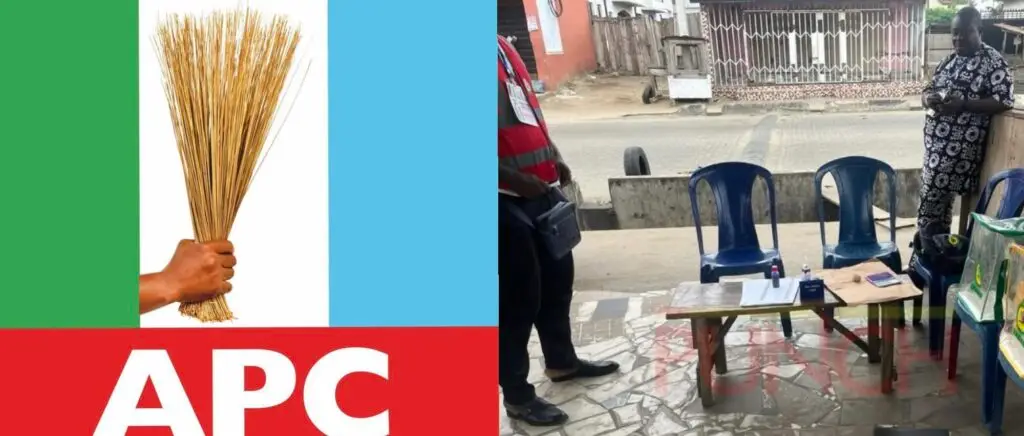
As residents of Lagos gear up for Saturday’s local council elections, tension remains high due to ongoing controversy surrounding the All Progressives Congress (APC) primaries, protests by discontented candidates, and security concerns over a police-imposed lockdown across the state.
The elections, which will take place across 20 Local Government Areas (LGAs) and 37 Local Council Development Areas (LCDAs), are seen as a significant political litmus test—not only for the ruling APC in Lagos but also for President Bola Ahmed Tinubu, as attention turns toward the 2027 national polls. Given that Lagos has traditionally been Tinubu’s stronghold, the outcome of this local vote, particularly after the Labour Party’s surprise performance in the 2023 presidential race, could indicate whether the party can retain unity and public support amid rising dissatisfaction and a growing opposition.
In May, the APC held its primary elections, approving more than 430 aspirants for chairmanship positions. However, the process faced notable challenges. In strategic LGAs such as Agege, Mushin, Ikeja, and Somolu, accusations of candidate imposition, lack of transparency, and manipulation of delegate rosters led to significant unrest. Protesters gathered at several APC secretariats, wielding placards and calling for justice, warning that support could be withdrawn if their preferred candidates were sidelined.
The party’s Appeal Committee, led by Lagos Attorney General and Commissioner for Justice, Lawal Pedro (SAN), reportedly received in excess of 100 petitions from displeased aspirants. Many alleged they had been unjustly disqualified or blocked from engaging with accredited delegates. Some went further, accusing influential party figures of selecting candidates based on allegiance rather than merit or popularity.
Despite the criticism, the APC defended the integrity of its process. During a formal unveiling of the party’s candidates, Barrister B.K. Ogala, Chairman of the Lagos APC Election Committee, claimed that the relatively low number of formal appeals—around 50 out of 439 contested positions—was proof that the primaries had been largely successful.
Nonetheless, controversies persisted. One of the most contested outcomes occurred in Agege, where Alhaji Tunde Azeez was named as the party’s chairmanship candidate under what many described as questionable circumstances. Azeez was accused of being imposed despite objections from various stakeholders. Rumours also swirled about Speaker Mudasiru Obasa’s son being positioned for the role, fueling speculation that the final choice involved internal threats and tactical bargaining.
Azeez was further accused of exploiting another contender’s health crisis for political gain—an accusation he publicly rejected. Similar disputes erupted in other LGAs, stoking fears that internal party conflicts could jeopardise APC’s chances in the upcoming elections.
Police enforce lockdown to deter violence
Amid the political unrest, the Lagos Police Command announced a 10-hour restriction of movement on election day. This directive, affecting road and water transport, will run from 6 a.m. to 3 p.m. throughout Lagos State.
Commissioner of Police Adegoke Fayoade stated that the measure aims to ensure public safety and prevent interference with the electoral process.
“Only accredited election officials, emergency workers, security agencies, and journalists with LASIEC-issued IDs will be allowed to move during the restricted period,” he said.
“Anyone or group attempting to interfere with the process will face arrest and prosecution,” the commissioner cautioned, noting that security personnel would be stationed strategically to deter violence and maintain order.
Opposition parties mobilise efforts
Opposition parties—particularly the Peoples Democratic Party (PDP) and the Labour Party (LP)—have expressed readiness to challenge APC dominance, although they acknowledge the ruling party’s deep-rooted control across the state.
PDP State Secretary Soji Orioye said the party was entering the elections with a clear strategy, expressing cautious optimism. “We are prepared as a party,” he noted. “We don’t need to exaggerate our chances. The APC has control at various levels. All we can do is stay focused on our goals.”
On the lockdown, Orioye described it as a necessary step for safety, though he added that “in normal conditions, elections shouldn’t last beyond four or five hours.”
The Labour Party, which performed impressively during the 2023 general elections in Lagos, is also fielding candidates across the LGAs and LCDAs. State Chairperson Dayo Ekong said the LP’s candidates are well-rooted in their communities and are approaching the elections seriously.
“The public is weary and ready for change—this could be the start of something better for their wellbeing,” she said.
Ekong also cautioned against vote-selling. “I urge voters not to trade their future for N5,000 and suffer for four years,” she warned.
Reacting to the recent formation of an opposition coalition led by the African Democratic Congress (ADC), Ekong was dismissive. “ADC hasn’t stabilised. Those who started the journey with us are still here, and our support continues to grow. Even if realignment occurs, Peter Obi remains influential in the Labour Party. We remain the viable alternative.”
She also highlighted safety concerns and called on authorities to avoid repeating the violent scenes seen during the 2023 elections in Lagos.
“Politics shouldn’t serve as an excuse to unleash violence on citizens. We appeal to the global community to stay alert—our actions here have broad implications,” Ekong stated.
LASIEC assures transparency, but critics remain doubtful
The Lagos State Independent Electoral Commission (LASIEC) has vowed to deliver a credible election, introducing biometric accreditation and pledging to upload results from 13,325 polling units in real time.
Justice Bola Okikiolu-Ighile (retd), LASIEC’s Chairperson, announced that 7,600,195 voters are registered to participate, with 6,214,975 PVCs already distributed.
During a Thursday press briefing, she stated that LASIEC had consulted with the media, civil society, political parties, and organisations for Persons Living With Disabilities (PWDs) to foster inclusion.
“Materials have already been sent to zonal offices. Our staff have undergone training and validation,” she said.
Voting will take place from 8 a.m. to 3 p.m.
She also confirmed that PWDs will receive priority treatment and may bring aides to assist at polling units. Pregnant women and seniors will likewise receive special consideration.
“We are committed to holding peaceful, fair elections. We urge all candidates to uphold democratic values,” she added.
Despite these pledges, some critics remain wary. Civil society actors and political analysts have pointed to historically low voter turnout and alleged LASIEC bias in previous elections.
Political commentator and former Lagos NCP Chair, Comrade Bayo Ogunleye, shared his doubts about the process’s integrity.
“In every state, SIEC-managed elections tend to favour the ruling party overwhelmingly,” he said. “Some political parties are already pulling out. In many areas, if you’re not with the APC, you can’t even campaign.”
He argued that APC’s control has stifled competition and discouraged voter participation. “This election will be no different,” he concluded.
As over seven million voters prepare to cast their ballots, analysts suggest that Saturday’s elections will not just shape local governance—they may also reflect how Lagosians perceive APC’s continued dominance and what that might mean for the 2027 national elections.
SEE MORE TRENDING TOPICS:
- This Must-Watch Adventure Epic Film Is Breaking the Internet
- Nigeria Pushes Back After US, UAE Announce Tougher Visa Policies
Pingback: Party Agent Decries Poor Turnout During Lagos Local Government Election