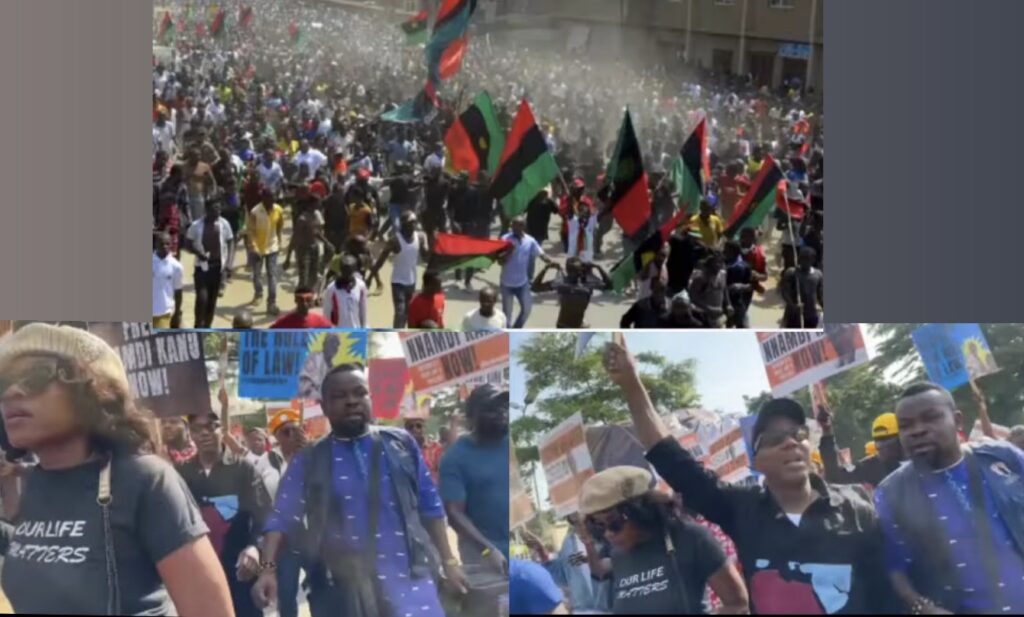
A wave of coordinated #FreeNnamdiKanu protests demanding the release of the detained leader of the Indigenous People of Biafra, Nnamdi Kanu, spread across the Federal Capital Territory and several South-East states on Monday, halting business activities and crippling transportation.
The demonstration, organised by activist and former presidential candidate Omoyele Sowore, who leads the #RevolutionNow movement, also prompted a heavy deployment of security operatives around key government locations, including the Three Arms Zone that houses the Aso Rock Presidential Villa, the National Assembly, and the Supreme Court.
In Abuja, several protesters were forcefully dispersed by security personnel who blocked their attempt to move towards the Villa. Roads leading to the Three Arms Zone were sealed off, and federal workers were temporarily denied access to key ministries for hours, causing massive traffic congestion across the city.
At the Villa area, armoured vehicles and armed officers from various security agencies surrounded the main routes and entry points.
WIZOPA observed that Yakubu Gowon Crescent in Asokoro, which leads into the Villa, was barricaded by Toyota Hilux vans while armoured carriers stood at both the entrance and exit. One of the security officials told our correspondent that the tight security was a preventive measure against protesters.
“It’s because of the protest. We were ordered not to let just anyone in today,” the officer said.
By 6am on Monday, joint teams of soldiers, police, and DSS operatives had already taken positions at strategic points, shutting down access roads to the Three Arms Zone.
Stop-and-search checks were increased, and movement around major government buildings was heavily limited. Even senior civil servants with official Villa access tags were turned back at various gates.
Pedestrians were allowed to walk through the barricades, but drivers were redirected to other routes.
The lockdown caused severe gridlock for thousands of commuters coming from Nyanya, Karu, Mararaba, and Masaka who were stuck for hours heading to work. Similar disruptions were seen along the Dutse–Bwari road and Airport Road, with several advisories urging workers to seek alternative paths.
Security patrols were also heightened around Eagle Square, the Federal Secretariat, and the National Assembly Complex, where anti-riot police and armoured trucks were stationed to block protesters.
The protest formed part of renewed pressure on the Federal Government to obey court rulings ordering Kanu’s release. The IPOB leader, who was arrested and extradited from Kenya in June 2021, remains detained by the DSS despite several bail rulings in his favour.
Supporters have repeatedly voiced concern over Kanu’s declining health and demanded his release for proper medical treatment. The government, however, insists he faces serious charges of treasonable felony and terrorism.
Sowore, a known advocate for civil rights and accountability, said the protest was meant to highlight what he described as “a blatant disregard for the rule of law.”
In the buildup to the demonstration, Sowore had mobilised supporters via social media, insisting that peaceful assembly is a constitutional right. He assured that the protest would be non-violent and urged police to safeguard protesters rather than harass them.
Security agencies had earlier expressed worries that the protest might escalate near sensitive government facilities.
On Monday morning, protesters including Sowore and other activists gathered at the Unity Fountain in Abuja, singing solidarity songs and holding placards demanding Kanu’s release.
Police officers fired several rounds of tear gas to disperse the protesters near barricaded zones, heightening tension in the area.
One of our correspondents reported that the protesters moved from Transcorp Hilton and nearby Maitama streets but regrouped around the Utako area, where they were again dispersed by police.
The Force later defended its actions, stating that officers acted within the law based on a valid court order restricting protesters from entering certain government areas.
Force Public Relations Officer, Benjamin Hundeyin, explained on Channels Television that the decision came from a Federal High Court order obtained on Friday.
He said the order specifically banned demonstrations near Aso Villa, the Supreme Court, the National Assembly, Eagle Square, Shehu Shagari Way, and other sensitive zones.
“We got a court order specifically for this protest, restricting access to areas like the Villa, Supreme Court, National Assembly, Eagle Square, Force Headquarters, and Shagari Way. As law enforcers, it’s our duty to uphold that order,” Hundeyin stated.
He added that the decision followed intelligence suggesting possible unrest if protesters breached those restricted areas, saying the police acted to prevent any breakdown of law and order.
“We’ve seen past protests turn violent, with properties destroyed. It’s our job to protect lives and property, and we’ll take all lawful measures to achieve that,” he added.
Hundeyin insisted that officers only used “minimal force” after repeated warnings were ignored.
“We told them to step back several times, but they refused. Tear gas was the least forceful option. Nobody was injured,” he said.
He dismissed rumours that live bullets were used, calling them false.
“No live ammunition was fired. Some may confuse the sound of tear gas launchers for gunfire, but only tear gas was used,” he clarified.
Hundeyin also said the court order was public and that protest organisers were summoned to court on Monday as part of ongoing proceedings.
NSCDC Condemns the Protest
The Nigeria Security and Civil Defence Corps (NSCDC) also condemned a morning protest at its headquarters in Abuja, calling it an anti-government gathering masked as a demand for justice.
NSCDC spokesperson, Afolabi Babawale, said over 50 people gathered at the Corps’ gate chanting protest songs and calling for Kanu’s release.
He described the action as “totally condemnable,” stating, “The protesters invaded the Corps headquarters entrance chanting various songs.”
Babawale said the Commandant-General, Prof. Ahmed Audi, had earlier ordered all state commands to heighten surveillance and secure national assets in preparation for the protest.
He noted that both undercover and uniformed operatives were deployed nationwide and across the FCT to prevent any possible disturbance.
Reiterating the Corps’ mandate, Babawale said their duties include protecting public assets, regulating private security firms, managing disasters, and supporting food security by safeguarding farmers and farmlands.
While acknowledging citizens’ rights to protest, he urged caution, saying such rights must be exercised within legal limits.
“The Corps recognises the right to lawful assembly, but restraint is necessary, especially where the court has barred such gatherings,” he said.
He urged collaboration between agencies, traditional leaders, and communities to protect national infrastructure.
Babawale warned that those arrested during the unrest would “face the full wrath of the law,” adding that the Corps would not condone any threats to national peace.
Abia, Anambra, and Enugu
At the same time, cities across the South-East including Onitsha, Enugu, Aba, and Owerri witnessed total shutdowns. Businesses, schools, and banks were closed, and residents observed what turned into an unofficial sit-at-home.
In Umuahia and Aba, compliance was total as banks, markets, and shops remained locked. Supporters of the Biafra movement gathered in the Umuahia city centre singing freedom songs and urging the Federal Government to free Kanu.
Some Igbo leaders also joined the call for dialogue and reconciliation.
In separate interviews with WIZOPA, the President General of Igbo Vanguard Group, James Uchegbuo, and that of Igbo Ekene Global Development Union, Moses Onyegbule, appealed for Kanu’s release through peaceful means.
Uchegbuo stressed that peace and dialogue are vital to rebuilding the region, saying their demand was not a rebellion against authority but a plea for justice and unity.
Onyegbule added that freeing Kanu would demonstrate the government’s commitment to national inclusion and healing.
In Anambra, residents observed the Monday sit-at-home in solidarity with the Abuja protest, despite IPOB’s earlier cancellation of the order in 2021. Most stayed indoors out of fear of attacks.
Commissioner of Police Ikioye Orutugu commended residents for maintaining peace and assured that security had been reinforced to protect lawful citizens.
Orutugu said the Command would continue adopting proactive strategies and strengthening community policing across the state.
Our correspondents who toured Onitsha, Nnewi, Awka, and other parts of Anambra found markets, schools, petrol stations, and motor parks shut down, with empty roads and deserted streets.
Major markets such as Onitsha Main Market, Ochanja, Mgbuka Amazu, Electrical Market, and Nkwo Nnewi were closed. A few roadside traders were spotted around Nkpor and Eke-Awka.
A resident, Jude Uzor from Okpoko, said, “People intensified the sit-at-home today in solidarity with the protest in Abuja. We support it because the government must obey the court order on Kanu.”
A market leader in Onitsha said, “Although the governor encouraged us to open on Mondays, today everyone stayed home out of solidarity and fear of hoodlums. The entire city is empty.”
Another passerby, John Okeke, added, “We only want Kanu’s release. The governors should use their influence to push for it because tomorrow it could be anyone else.”
The police in Anambra also confirmed conducting a security assessment after receiving intelligence about planned protests. Spokesman Tochukwu Ikenga said residents had embraced peaceful dialogue rather than confrontation.
In Ebonyi State, there were no major protest marches, but cities were deserted as banks, schools, offices, and markets were closed. Only a few motorcycles moved within Abakaliki, while motor parks were empty.
Security agents were stationed across the city but later withdrew when no protests occurred.
When WIZOPA visited the area, the streets were quiet, shops closed, and only a few pedestrians walked around. Areas such as Water Works Road, Afikpo Road, and Gunning Street were completely empty.
In Ondo State, Igbo traders also joined the solidarity protest by locking up their shops, especially along Oyemekun, Adesida, Arakale, NEPA, and Old Garage roads in Akure.
Only non-Igbo traders opened for business. One woman, Nkechi, said, “We stayed home to show our support. If we can’t be in Abuja, this is our own protest. They should release Kanu. It’s unfair to keep him for years. Tinubu should do this one thing for us.”
Our correspondent observed a strong presence of security agents around usual protest spots in Akure.
SEE MORE RELATED NEWS :
• How to free Nnamdi Kanu – Minister Of Work
• US Embassy Issues Security Alert Ahead of #FreeNnamdiKanuNow Protest in Abuja
• #FreeNnamdiKanu: Protesters Defy Police Warning, Plan Presidential Villa March
• IPOB Seeks Adequate Police Protection For #FreeNnamdiKanuNow Protesters On October 20